When planning a new building backbone, a link between two system rooms or a campus connection, the first technical decision is usually the same: single-mode or multimode fiber? This choice determines not only the price of the cable but also the cost of the optical modules to be used, the distance that can be reached and whether the infrastructure will still be adequate in 10 years. In this article we explain in plain terms the difference between single-mode and multimode fiber, the technical values of the OM3, OM4, OM5 and OS2 classes, and which one to choose in which scenario for enterprise projects.
The Basic Difference Between Single-Mode and Multimode Fiber
Both fiber types carry light inside a glass core; the difference lies in the diameter of the core and the number of light paths (modes) that can travel through it. This distinction is the starting point for everything that determines cable performance. If you are curious about the general structure of fiber cable, see our guide to the structure and types of fiber optic cable.
Single-mode fiber
In single-mode fiber the core diameter is about 9 micrometres (referred to on the market as 9/125 µm). Because the core is so thin, light travels along almost a single path. Since light signals do not arrive at different times via different paths, there is no modal dispersion and the signal can be carried over kilometres. Single-mode links use laser-based optical modules operating at 1310 nm and 1550 nm wavelengths.
Multimode fiber
In multimode fiber the core diameter is 50 µm (OM2–OM5) or 62.5 µm (OM1). The wider core allows light to travel along many different paths. This is not a problem over short distances; but as distance increases, light pulses arriving via different paths blur into each other and the bandwidth that can be carried drops. Multimode systems mainly operate at 850 nm with low-cost laser sources called VCSELs.
Comparison Table: Single-Mode vs Multimode
| Feature | Single-mode (OS1/OS2) | Multimode (OM1–OM5) |
|---|---|---|
| Core diameter | About 9 µm | 50 µm or 62.5 µm |
| Typical wavelength | 1310 / 1550 nm | 850 nm (and 1300 nm) |
| Light source | Laser | VCSEL (LED in older systems) |
| Distance | Kilometres | Roughly 100–550 m depending on speed |
| Optical module cost | Generally higher | Generally lower |
| Typical use | Between buildings, campus, metro links | In-building backbone, intra-data center links |
| Jacket colour (TIA-598) | Yellow | Orange, aqua or lime green |
What Is the Difference Between OM1, OM2, OM3, OM4 and OM5?
Multimode fibers are defined in the ISO/IEC 11801 standard by OM (Optical Multimode) classes. The main difference between the classes is the modal bandwidth offered at 850 nm. The higher the bandwidth, the longer the distance that can be reached at the same speed.
- OM1 (62.5/125 µm): An older-generation fiber designed for LED sources. It offers 200 MHz·km bandwidth at 850 nm. Not chosen for new projects.
- OM2 (50/125 µm): Has 500 MHz·km bandwidth. Sufficient for gigabit, but its reach at 10G is very short.
- OM3 (50/125 µm, laser-optimised): Effective bandwidth of 2000 MHz·km. It was the standard choice for a long time in short-reach 10G and 40/100G applications.
- OM4 (50/125 µm, laser-optimised): Effective bandwidth rises to 4700 MHz·km. Today it is the most common multimode class in enterprise in-building backbones and data centers.
- OM5 (50/125 µm, wideband): Offers the same performance as OM4 at 850 nm and is additionally designed to work at wavelengths above 850 nm (roughly the 880–940 nm range). This allows it to be used with SWDM-based modules that carry multiple wavelengths over a single fiber pair.
Maximum distances by multimode class
The table below summarises the typical distances supported for each OM class in IEEE Ethernet standards. Because the number of connectors and splices in the field affects the total loss budget, these values should be treated as upper limits.
| Fiber class | 1000BASE-SX (1G) | 10GBASE-SR (10G) | 40GBASE-SR4 (40G) | 100GBASE-SR4 (100G) |
|---|---|---|---|---|
| OM1 | 275 m | 33 m | Not supported | Not supported |
| OM2 | 550 m | 82 m | Not supported | Not supported |
| OM3 | Up to 550 m | 300 m | 100 m | 70 m |
| OM4 | Up to 550 m | 400 m | 150 m | 100 m |
| OM5 | Up to 550 m | 400 m | 150 m | 100 m |
As the table shows, when moving to 100G multimode distances drop to around 100 metres. Inside a data center this is often enough; but if there is a longer link between building floors or blocks, single-mode comes into consideration.
OS1 and OS2 Single-Mode Fiber
Single-mode fibers are defined by OS (Optical Single-mode) classes. Cable standards specify a maximum attenuation of 1.0 dB/km for OS1 and 0.4 dB/km for OS2; OS1 is associated more with indoor tight-buffered cables and OS2 with outdoor and loose-tube cables. Today most single-mode cable on the market is made with ITU-T G.652.D-compliant fiber and sold as OS2. Where there are tight bends inside buildings, G.657 class fibers, which are more resistant to bending, may be preferred.
On the single-mode side, the distance limit in practice comes from the optical module rather than the fiber. Different options can be used on the same OS2 link, from modules reaching a few hundred metres to modules carrying tens of kilometres. This flexibility makes single-mode infrastructure a strong candidate for long-term investments.
Identifying Fiber Type by Colour Code
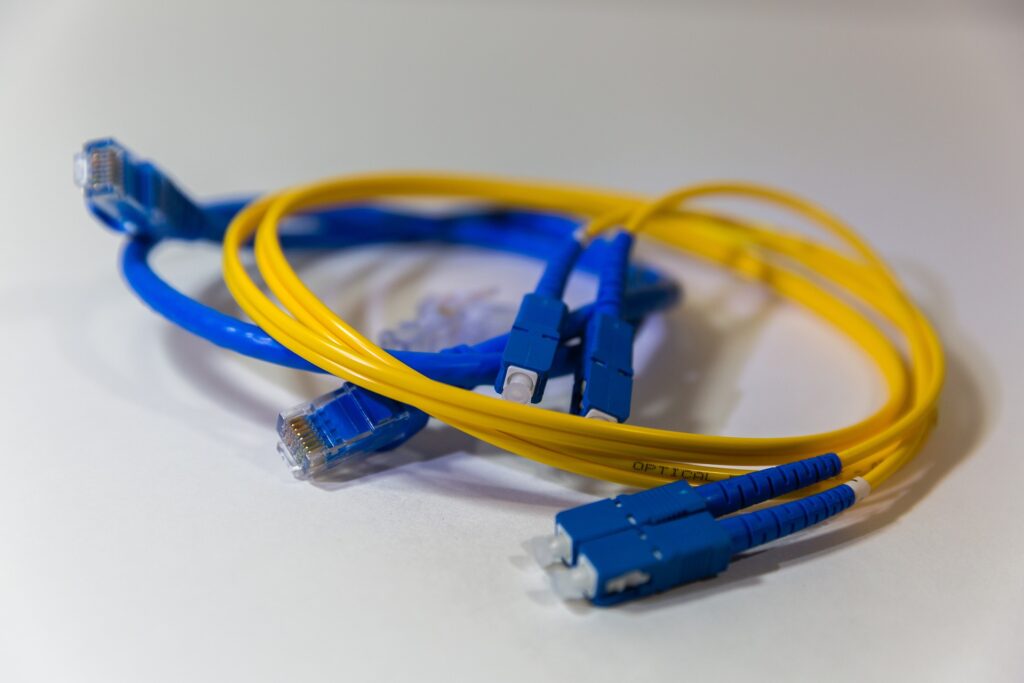
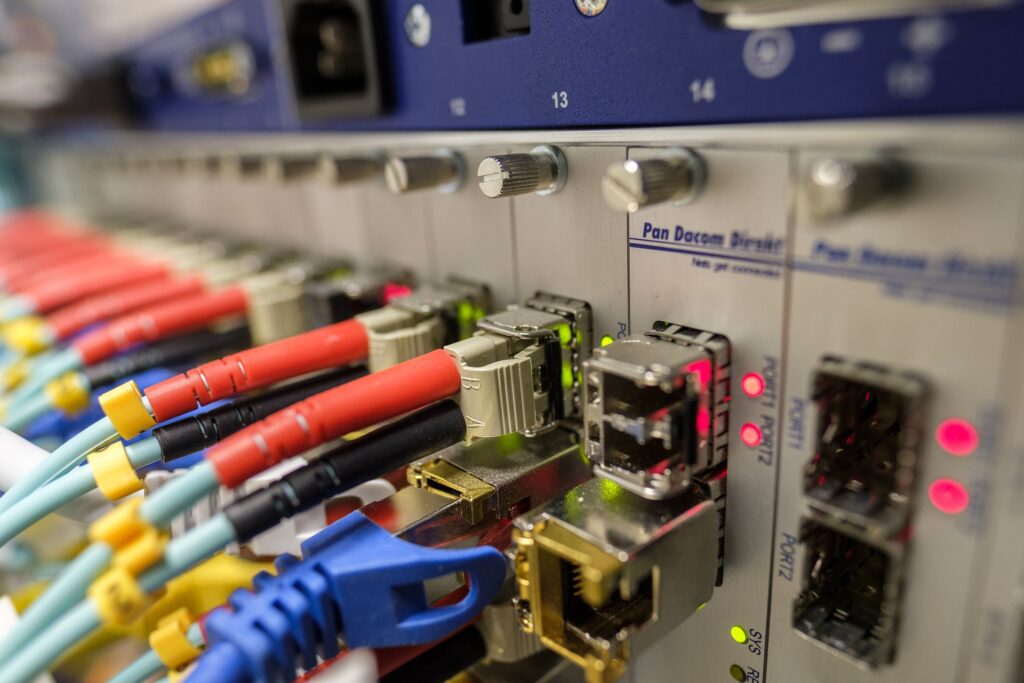
The quickest way to tell the type of an existing link in the field is to look at the jacket and connector colours. Under the TIA-598 standard, common indoor colours are:
- Orange jacket: OM1 and OM2
- Aqua jacket: OM3 and OM4 (some manufacturers also use violet/erika violet to distinguish OM4)
- Lime green jacket: OM5
- Yellow jacket: Single-mode (OS1/OS2)
- Connector colour: Single-mode UPC/PC connectors are blue, APC (angle-polished) connectors green; laser-optimised multimode connectors are aqua and OM5 connectors lime.
Colours offer a practical hint, but not every manufacturer follows the standard exactly. For a definitive identification, read the print on the cable jacket and take a measurement if necessary.
Which Fiber for Which Scenario?
The right choice is made by considering distance, target speed, existing active equipment and budget together. The following steps simplify the decision:
- Measure the longest link distance. Calculate the actual cable length along the route (including vertical risers and service loops). For links over 100 metres that are expected to carry 100G in future, single-mode is the safer choice.
- Define the target speed and 10-year plan. Even if 10G is enough today, cabling is usually used much longer than active equipment. Replacing cable is far more disruptive than replacing modules.
- Check compatibility with existing infrastructure. If the building has an OM3/OM4 backbone and distances are short, continuing with the same class makes patch cord and module compatibility easier. Mixing different core diameters (50 µm and 62.5 µm) on the same link causes serious losses.
- Evaluate total cost. The price difference between multimode and single-mode cable is usually small; the real difference shows up in the optical modules. In data center projects with high port counts, this difference can be decisive.
- Take environmental conditions into account. Loose-tube, armoured OS2 cables should be preferred for links between buildings and outdoors, and cables with high bend resistance inside buildings.
Quick summary: practical recommendations
- Inside a data center or system room, under 100 m: OM4 multimode is a balanced solution for most organisations.
- In-building floor backbone, 150–300 m: OM4 if 10G is enough; OS2 single-mode if 40/100G is the target.
- Between buildings, campus or factory site: OS2 single-mode.
- If new-generation SWDM modules are planned: OM5 can be considered, but the module ecosystem and cost should be checked first.
Points to Watch During Installation and Testing
Choosing the right fiber type is half the job; the other half that determines performance is installation quality. Clean connector end faces, splice quality and respecting the bend radius are critical, especially in applications with tight loss budgets such as 40G and 100G. You can find details on how link ends are connected in our article on the fiber termination process.
After installation, it is recommended that every link be loss-tested with a light source and power meter, and that splice and connector points on long links be verified individually with OTDR testing. Test reports are also a valuable reference for comparison when faults occur later. We cover how to plan the fiber backbone together with copper horizontal cabling in detail in our structured cabling planning guide.
Conclusion
The difference between single-mode and multimode fiber comes down to core diameter, but it has a direct effect on distance, speed, module cost and future growth capacity. For short-reach data center links OM4 multimode is still an economical and strong option, while OS2 single-mode stands out for links between buildings and for long-term high-speed plans. The soundest decision is made by considering the project's distance measurements and 10-year capacity plan together.
If you are not sure which fiber type is right for your building or campus, Infranet supports you through site survey, design, installation and testing with our fiber cabling solutions. Contact us to discuss your existing infrastructure and goals.